Pages

Monday, May 23, 2011

Paintings, Pictures and Portraits, Oh My!

Repeat with me:

A painting can be a portrait or a picture.
A portrait can be a picture or a painting.
A picture can be a portrait but not a painting.

These words are not interchangeable. At least in "A Picasso."

This coming from the girl who gets Barstow, Belmont and Butler mixed up because they all start with Bs.

Sunday, May 22, 2011

Research: Nazi armbands

As far as I know, the word Nazi appears only once in "A Picasso." Today I was talking to my husband about the play and he was surprised by the lack of the term's appearance.  


He asked if I was going to be wearing a Nazi armband. I told him I didn't think my character would be required to wear one because she is just part of the Ministry of Culture. He said I should research that, so I did. 


I relayed to him an early conversation Heather, Jag and I had about whether our set should contain a Nazi Party flag hanging in the background.  I was opposed to the idea since I thought it would make the show solely about Nazis and less about art. Manuel felt the flag should at least be in the Lobby or Hallway since the circumstances in the play would never exist without Nazis  This made me think: Am I wrong?  I really feel the more powerful approach would just to have stacks and stacks of paintings lining the set, and if possible the hallways and lobby to give the audience the feeling of walking into a warehouse and to set the somber mood. After watching "The Rape of Europa" I was struck by the images of paintings stacked against walls. I thought, who were these stolen from? What became of those pictures? 
The Jeu de Paume - The "hub" of Nazi-confiscated art.

However, I am willing to admit that I may have been wrong. Since Heather and Jag were leaning in the flag direction, and now Manuel is, maybe I'm the only one not on board.  Manuel thought the armband, at the very least would be a good idea, and I was thinking the Nazi party pins the antique stores have loads of would also work in its place. 

I'm having flashbacks to the terrible feeling I had when spouting off all those anti-semitic things to Jag in Merchant of Venice. I would have never thought that in my life I would find myself wearing Nazi paraphernalia. It makes me a little uneasy, but at least I'm not the one who would have to be staring at it the whole time. 


So here's my research:


Nazi Armband System

The "armband system" was instituted by the Nazi Party in 1939. The purpose of the armband system was to denote positional titles within the Nazi Party.

There were three groupings of armbands, classified as "operational", "administrative", and "command". The operational armbands were used by Nazi party political leaders on the local and county levels of the Party and were worn by those Party leaders directly engaged in implementing Party policies to the public. During World War II, this was most often associated with food rationing, war relief efforts, and civil defense.

The administrative armbands were worn by office staffs across all levels of the party, although mostly were used by the regional staffs of the Gauleiters.


I'm thinking that a woman working for the ministry of culture in 1941 would most likely have worn a Nazi armband, after all. Reproductions of them are only $10 online, so I'm wondering if we should get one. I'm not sure how much the Nazi pins are at the antique store.


Nazi Pins
The Golden Party Badge (above) was the basic Nazi Party Badge with the addition of a gold wreath completely encircling the badge. The badge was awarded in two sizes: 30.5 mm for uniforms and 24 mm for civilian jackets. It was worn by the first 100,000 members of the party (these were denoted by the party members' number stamped on the reverse)

Guess what number Hitler had stamped on the reverse of his pin?  Yup, number 1.

Jerk.

Memorization

My favorite place to memorize is at Revue on Saturday mornings!

I love memorizing. I have all the elvish lines spoken in the Lord of the Rings films stored in my brain and I sometimes spout them off angrily to sound like I'm cussing folks out.  I also have "Supercalifragislisticexpialidocious" memorized "backwards" as it appears in the song as well as the alphabet spoken as one long word. These come especially handy when my students are noisy beyond all reason. I start sharing my useless knowledge with a couple dutiful students and suddenly like a wave the rest of the students want to hear what I'm saying. Go figure.

I'm interested in knowing how other people memorize scripts. I do it the typical way, at least I'm pretty sure it's typical. I pick one line, then add the next line in succession and go back and test whether I've got that section and so forth.  When googling effective memorization strategies, I saw a recommendation to write out your own lines in your own handwriting to access a different part of the brain, or even to record them and play them back either with your lines spoken or with a space left where your lines should be.

Do people actually do that? It doesn't seem necessary, but who knows!


The thing I'm currently struggling with is Jeffrey Hatcher's style of writing. There are some sections where my lines just don't seem to belong next to each other. I would tell my students this is choppy writing and to add some sort of transitions between the thoughts. I think that's what's leading to my cutting myself off in rehearsals; I'm really snippy and short with my thoughts rather than drawing them out.

Part of it night be that the two parts I have the most trouble with are later in the script, which I, admittedly have not devoted as much time to practicing. I really need to spend some time working through the beats and figuring out which thoughts connect to each other.  Hopefully going off-book this week will help me.

Here is an example (with the bold part being the parts I can't seem to connect without sounding choppy):

"There was a show, a group show in '35. He begged to be a part of it, the notoriety. He hadn't had much success. It was very political. They even issued a manifesto, very brave, which he signed in very big letters."

Wednesday, May 18, 2011

Insecurities

Things I'm insecure about:

Numero Uno: Spitting on people, especially someone who is my friend!

Let me tell you about the number of times I have exchanged any type of bodily fluids with anyone:
  1. I kissed this guy in Denmark in the 7th grade who tricked me by betting two girls he could get me to kiss him behind the theater curtain. I kissed him... two girls jumped out behind a box out, giggling.
  2. Marrying Manuel.  I'm serious.
So, not to mention how bad I feel spitting on poor Jag. I'm normally a pretty nice person and can't believe how mean I must act to him. I can't believe he's okay with this.  This reminds me of when I had to spout all those anti-Semitic remarks to him in Merchant and would always feel utterly crappy about myself afterwards. Jag's response to me: "You have restored my faith in humanity."

Numero Dos: Being expected to look attractive. Especially with my mouth open. Hahaha! Yeah.

The other insecurities can't be listed here because they will reveal too much of the plot.  ;-)

Research: Guernica


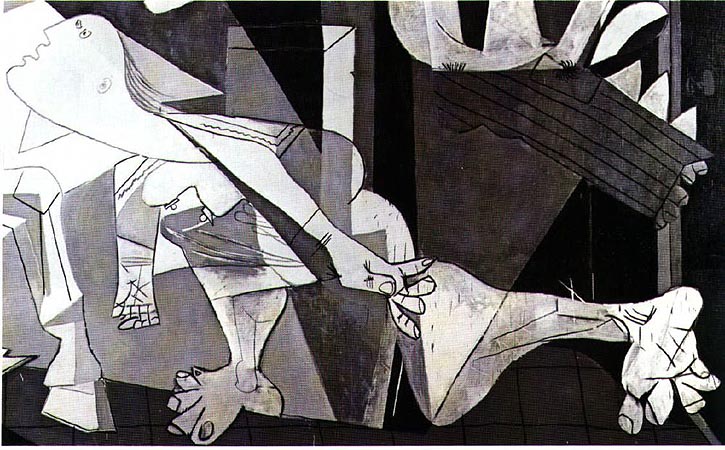
Guernica is a painting central to understanding the motivations behind both characters in "a Picasso"  I have become slightly obsessed with this painting, and through my digging have discovered quite a number of amazing facts (mostly from Wikipedia, but again, extremely condensed to the pertinent info and with a million images added to enhance your experience).  For example, I had no idea of the sheer enormity of the painting:


Guernica is grey, black and white, 11 ft tall and 25.6 ft wide, a mural-size canvas painted in oil. Picasso's purpose in painting it was to bring the world's attention to the bombing of the Basque town of Guernica by German bombers, who were supporting Franco during the Spanish Civil War.  Picasso completed the painting by mid-June 1937.


Deaths in Guernica:
In 1937, von Richthofen wrote that most of Guernica's inhabiatants were away on holiday resulting in few deaths.  However, other accounts state that the town's inhabitants were in fact congregated in the center of town, as it was market day, and when the bombardment commenced, were unable to escape the inferno because the roads leading out of the center of the town were full of debris and the bridges leading out of town had been destroyed.


Guernica shows suffering people, animals, and buildings wrenched by violence and chaos.

Painting details:
I condensed all the symbolic awesomeness to a few key items:
  • The overall scene is within a room where, at an open end on the left, a wide-eyed bull stands over a woman grieving over a dead child in her arms.
  • The centre is occupied by a horse falling in agony as it had just been run through by a spear or javelin. The large gaping wound in the horse's side is a major focus of the painting.
  • Two "hidden" images formed by the horse appear in Guernica:
    • A human skull overlays the horse's body.
    • A bull appears to gore the horse from underneath. The bull's head is formed mainly by the horse's entire front leg which has the knee on the ground. The leg's knee cap forms the head's nose. A horn appears within the horse's breast.
  • Under the horse is a dead, apparently dismembered soldier; his hand on a severed arm still grasps a shattered sword from which a flower grows.
  • On the open palm of the dead soldier is a stigma, a symbol of martyrdom.
  • A light bulb blazes in the shape of an evil eye over the suffering horse's head (the bare bulb of the torturer's cell.) This is related to the Spanish word for lightbulb; "bombilla", which makes an allusion to "bomb".
  • To the upper right of the horse, a frightened female figure, who seems to be witnessing the scenes before her, appears to have floated into the room through a window. Her arm, also floating in, carries a flame-lit lamp. The lamp is positioned very close to the bulb, and is a symbol of hope, clashing with the lightbulb.
  • Daggers that suggest screaming replace the tongues of the bull, grieving woman, and horse.
  • On the far right, a figure with arms raised in terror is entrapped by fire from above and below.

Symbolism and interpretations

The following list of interpretations reflects the general consensus of historians:

  • The shape and posture of the bodies express protest.
  • Picasso uses black, white, and grey paint to set a somber mood and express pain and chaos.
  • Flaming buildings and crumbling walls not only express the destruction of Guernica, but reflect the destructive power of civil war.
  • The newspaper print used in the painting reflects how Picasso learned of the massacre.
  • The broken sword near the bottom of the painting symbolizes the defeat of the people at the hand of their tormentors.

Picasso's comments on the work


When pressed to explain symbols in Guernica, Picasso said,
...this bull is a bull and this horse is a horse... If you give a meaning to certain things in my paintings it may be very true, but it is not my idea to give this meaning. What ideas and conclusions you have got I obtained too, but instinctively, unconsciously. I make the painting for the painting. I paint the objects for what they are.[3] 
 However, Picasso said as he worked on the mural: 

"The Spanish struggle is the fight of reaction against the people, against freedom. My whole life as an artist has been nothing more than a continuous struggle against reaction and the death of art. How could anybody think for a moment that I could be in agreement with reaction and death? ... In the panel on which I am working, which I shall call Guernica, and in all my recent works of art, I clearly express my abhorrence of the military caste which has sunk Spain in an ocean of pain and death."
But far from being a mere political painting, Guernica should be seen as Picasso’s comment on what art can actually contribute towards the self-assertion that liberates every human being and protects the individual against overwhelming forces such as political crime, war, and death.[7]

And then there's this:

While living in Nazi-occupied Paris during World War II, Picasso suffered harassment from the Gestapo. One officer allegedly asked him, upon seeing a photo of Guernica in his apartment, "Did you do that?" Picasso responded, "No, you did."
 

Tuesday, May 17, 2011

The Painting.


I had a revelation about Miss Fischer today. Through Miss Fischer's lines one might assume she is extremely interested in art. "What is it, chalk? Charcoal?"  "Is that how you did this one? With a mirror?" "Am I right about the period?"

However, in the staging yesterday, I realized I wasn't drawn to the portraits when asking those questions, but to Jag's reactions. It could just be that we were holding imaginary paintings in our hands and there wasn't actually much to look at... but it was an interesting notion to me that as Picasso studies the portraits. Miss Fischer studies Picasso.

He is the painting.  And she is the critic.

...take that as you will.

Monday, May 16, 2011

Today I learned...

Today I learned why actors have lower incidence of Alzheimer's.

Rehearsals make my brain hurt; I can only assume this is because of how many areas are being accessed at once.

There is so much involved in rehearsal. Basically it's simultaneously:
1) Recalling memorized lines
2) ...while at the same time trying to convey appropriate emotion
3) ... trying to remember where to stand
4) ... and add to all of that: Trying to produce a consistent accent

OUCH!!!  I think every area of my brain is lit up at once.

Here... memorize this with an accent and move to a table while reciting it:
I em pratty suure zis iss mye brein:


I am in no way complaining... rehearsals are my absolute favorite thing in the world. Learning and challenging myself makes me so. very. happy.

And being happy has only attracted even more amazing things into my life.

By the way, I found a photo of my "odd" work ensemble I mentioned a few posts back:


The two kids on the left really are nerds. I am so in awe of them!!!  
...Do you think I am I trying too hard?